


There is no single best PSI. The rating you need is set by the hardest surface you clean, and what reaches that surface is set by the nozzle and the distance. The one published ceiling is for vehicles: BLAHST's FAQ gives no more than 2,000 PSI when cleaning a vehicle. For concrete, timber decks and boats, none of the Australian guidance cited here gives a PSI figure, so the method below does the work the number cannot.
Three things decide the result on any job: the rating (PSI), the flow (litres per minute) and the nozzle you fit.
Is 1800 PSI good for a pressure washer?
Yes, for vehicles and lighter cleaning at home. An 1,800 PSI rating sits under the 2,000 PSI ceiling on BLAHST's FAQ. It covers a car, a ute, a dirt bike and outdoor furniture, with the nozzle doing the safety work: 15 degrees or wider on any vehicle, and the 25 or 40 degree tip on panels.
What an 1,800 PSI washer gives up is time on hard surfaces. A driveway that has held oil and tyre marks for a year takes more passes at 1,800 PSI than at a higher rating with the same flow. For a household that washes vehicles most weekends and a path a few times a year, 1,800 PSI is a sound rating.
Is 2200 PSI good for a pressure washer?
Yes, with the nozzle and distance matched to the surface, because no source in this guide sets a PSI for driveways, decks or boats.
On a car it is above the 2,000 PSI ceiling, and that changes the method rather than ruling the washer out. Fit a 25 or 40 degree nozzle and keep at least 30 cm between the nozzle and the paint, the distance Tesla's Australian Model Y Owner's Manual | Tesla sets. Keep the lance moving. Never fit a quick-connect nozzle under 15 degrees on a vehicle, which is the FAQ's rule for BLAHST's own washers. The detail for paint, wheels, trims and seals is in What PSI pressure washer is safe for a car?.
2500 vs 3000 PSI pressure washer: which do you need?
For the surfaces in this guide, neither is a target. The extra 500 PSI is margin the nozzle and distance have to manage, and both ratings sit above the vehicle ceiling. On concrete both clean a slab, and at the same flow the 3,000 PSI unit does it in fewer passes.
Two things count for more than the gap. The first is flow. A slab is rinsed by litres as much as by pressure, so a 2,500 PSI washer with more flow can finish a driveway sooner than a 3,000 PSI washer with less. The second is attachments. A surface cleaner, foam cannon or extension lance carries its own pressure rating, and that rating has to be at or above the washer's maximum, not its working pressure.
No surface in this guide has a published figure that calls for 3,000 PSI or more.
What does LPM mean on a pressure washer?
LPM is litres per minute, the volume of water the pump pushes through the nozzle, also written L/min. A washer rated at 8 L/min moves up to 8 litres through the nozzle for every minute the trigger is held. Check whether that is the rated or the maximum flow, as some washers publish both.
Pressure and flow do different jobs. Pressure breaks dirt loose from the surface; flow carries it away. A washer with high pressure and low flow loosens grime and leaves it sitting on the slab as streaks. A washer with high flow and low pressure moves a lot of water over dirt it has not lifted.
More litres does not mean more cleaning power. A higher flow figure means faster rinsing and more water used, not a cleaner panel. Flow is also the figure to read on tank water: multiply L/min by the minutes the trigger is held and you have the most the wash can draw.
What PSI do you need for a concrete driveway?
Australian concrete guidance gives no PSI for cleaning a driveway, so choose by method. Cement Concrete & Aggregates Australia's data sheet Residential Concrete Driveways and Paths says high-pressure water is typically used for general cleaning. For the chemical stain removers used alongside it, the data sheet cautions about their effect on surface sealers and on the colour and texture of the surface, and suggests mild detergent and steam cleaning first on colour-sensitive concrete.
Start with the 25 degree nozzle at arm's length on a corner nobody sees, and check the surface before you move on. A sealed or coloured driveway can show a lighter patch where the pressure or the nozzle was too aggressive. Keep the lance moving in overlapping passes, and use the 15 degree nozzle only on stains the wider fan leaves behind. For an even finish across a whole slab without wand stripes, a surface cleaner is the tool, and How Do I Clean My Driveway Using a Pressure Washer Surface Cleaner? covers that job.
Can you pressure wash a timber deck?
Yes, as the rinse step after a deck cleaner, with a wide nozzle held off the boards and moved along the grain. Cabot's instructions for Deck Clean | Cabot's read: "Rinse off the surface with water using a high pressure or garden hose". Intergrain's UltraPrep Timber Cleaner | Timber Cleaning Solution | Intergrain goes further: "A high pressure water cleaner is recommended for large areas or badly discoloured timber."
Neither maker gives a PSI. In both methods the cleaner does the lifting while it dwells on the timber, and the washer rinses it off. Hold a narrow jet close to softwood and it lifts the surface fibres, which is the fur that appears when the deck dries. Cabot's says to test the cleaner on a small area first; do the same with the washer, on a board under the outdoor table. Outdoor timber furniture follows the same rules with more distance, because its sections are thinner than decking boards.
What PSI is safe for a boat or a 4WD?
For a 4WD, the 2,000 PSI vehicle ceiling on BLAHST's FAQ applies. For a boat no PSI is published, so both get the vehicle method: no nozzle under 15 degrees, at least 30 cm, and the lance moving. Tesla's manual gives the reason to rinse underneath as well as on top. It tells owners to "rinse away any road salt from the underside of the vehicle, wheel wells, and brakes." After a beach run or a red-dirt trip, the chassis rails and wheel arches carry the salt and dust. Rinse from the underside up, then the panels with the 25 or 40 degree nozzle. Caked mud in an arch is where the 15 degree nozzle earns its spot, still at 30 cm.
On a boat, salt is the priority: rinse the hull, trailer and outboard the day the boat comes out of the water, with the wide nozzle on gelcoat, decals, seals and the cowl seams. Never send a narrow jet into the cowl vents or the trailer's brake and bearing assemblies.
Common mistakes when choosing PSI
Buying the highest rating in the shop. Every rating above 2,000 PSI is above the vehicle ceiling, so the higher the number, the more of each wash is spent managing it.
Pairing an attachment rated below the washer's maximum. The surface cleaner, foam cannon or extension lance needs a rating at or above the washer's maximum pressure, not its working figure.
Reaching for the 0 degree tip for general cleaning. It puts the whole output on a pinpoint, which lifts paint, raises timber fibres and can mark concrete.
Buying the smaller washer for hard surfaces. BLAHST sizes the R18 for vehicle washing and lighter domestic cleaning, and names the R30 as the step up for hard surfaces. A buyer who takes the R18 to a long concrete driveway is working against its sizing.
Frequently asked questions
Is 300 PSI enough to wash a car?
Safe, yes; enough on its own, only for a lightly dirty car. A 300 PSI rating sits far below the 2,000 PSI ceiling, so the rating is not the risk to paint. What it will not do is lift caked mud or road film by itself, so let a foam pre-wash do the lifting and rinse with the 300 PSI unit.
What is a good PSI pressure washer for home use?
One rated for the hardest surface you own, with the nozzle set for the softest. A home that washes vehicles only is served under 2,000 PSI. A home with a concrete driveway as well saves passes with a higher rating, run on vehicles with a wide nozzle at 30 cm.
Can you adjust the PSI on a pressure washer?
On most electric domestic washers, no: the rating is fixed by the pump, and what you adjust is what reaches the surface. The nozzle angle spreads the same water across a wider fan, and distance spreads it further. Some guns and variable nozzles change the spray pattern with a twist rather than a swap.
Choosing between the BLAHST R18 and R30
Pick the washer by the hardest surface on the property. For vehicle washing and lighter domestic cleaning, the R18 is the one sized for the job. For a driveway, paths or a patio as well, BLAHST names the R30 as the step up for hard surfaces, and in customer reviews the R30 is described as the more powerful of the two.
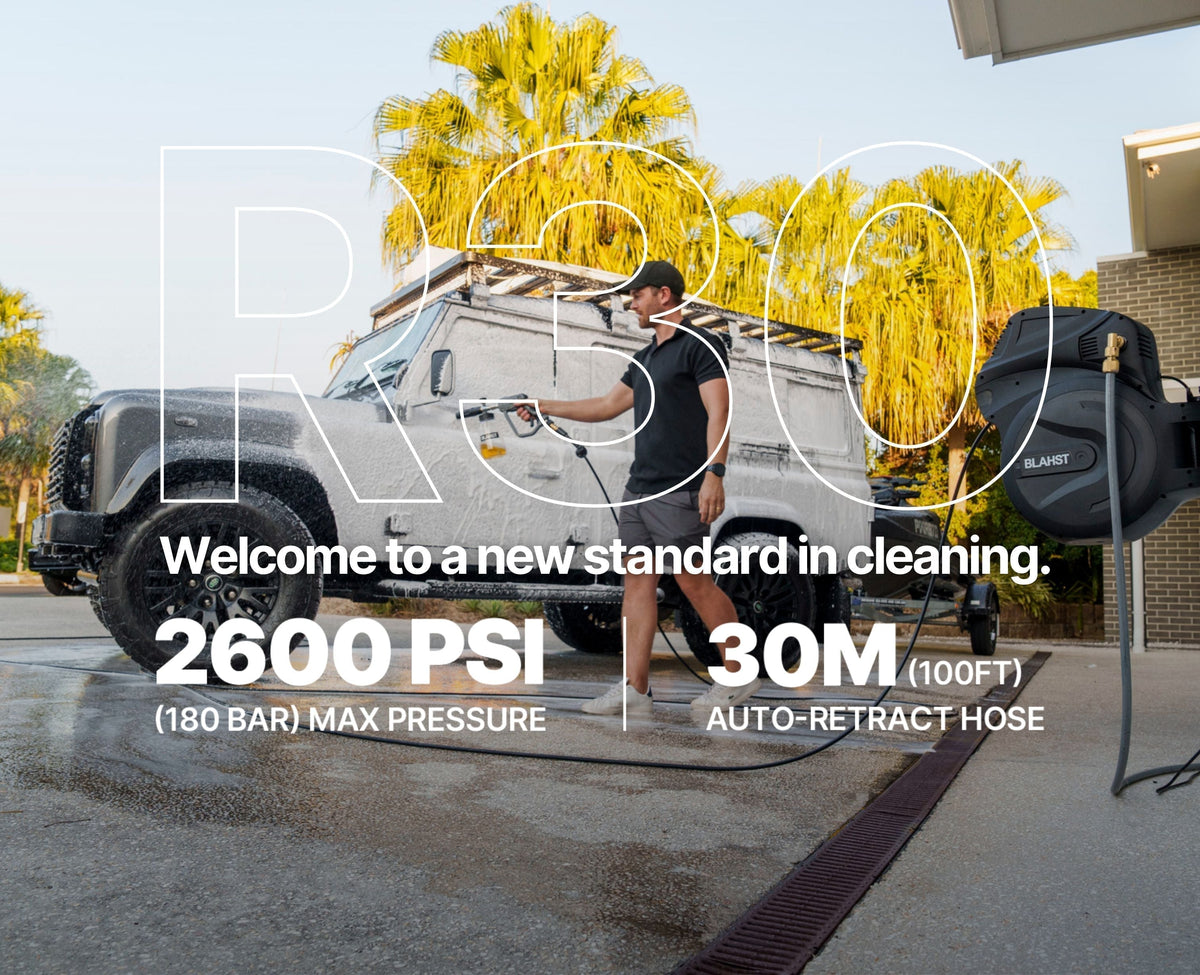
The R30 Wall-Mounted Pressure Washer is rated at 2300 PSI working pressure and 2600 PSI maximum. Both figures sit above the 2,000 PSI vehicle ceiling. On a vehicle the R30 runs on the same rule as any washer in this guide: no quick-connect nozzle under 15 degrees, 30 cm from the paint, lance moving.
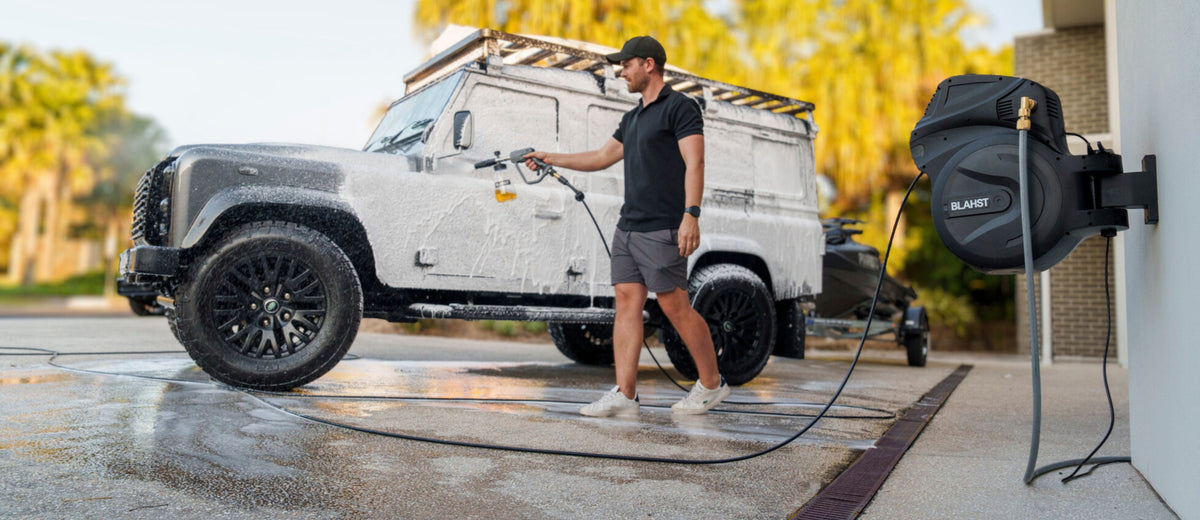
The R30's 30 metre retractable hose reaches right around a car, 4WD, boat or caravan without moving the unit, so you can hold 30 cm on the far side of a dual-cab or a hull on its trailer. The unit stays mounted on the wall and the hose retracts when the wash ends, with nothing to set up or pack down. "no setup hassle, just switch on tap and power and off you go" (Verified customer review)
BLAHST publishes the intended use for its wall-mounted washers as domestic and occasional light trade cleaning of vehicles, 4WDs, boats, caravans, patios, decks, paths and driveways (Warranty Policy Product Warranty Australia). Within that, the R18 suits vehicle washing and lighter domestic jobs, and the R30 is the model for hard surfaces.


Share:
Electric vs petrol pressure washer: which suits your home and car?
4WD underbody cleaner: how to wash under a 4WD after a trip