


Wash a car at or under 2,000 PSI, with a nozzle of 15 degrees or wider held at least 30 cm from the paint. BLAHST's FAQ sets the 2,000 PSI ceiling and the nozzle rule. The 30 cm distance comes from the car makers: Tesla's Australian Model Y Owner's Manual | Tesla tells owners to keep at least 30 cm between the nozzle and the car.
The number on the box matters less than three things you control: the nozzle angle, the distance and the water flow. A wider nozzle spreads the jet over a larger patch of paint, distance spreads it further, and flow carries the loosened dirt off the panel.
Will 2000 PSI damage car paint?
Not on its own. BLAHST's FAQ puts the ceiling for washing a vehicle at 2,000 PSI, so treat 2,000 PSI as the upper limit for paint. Damage at that pressure comes from the pencil jet held close: a 0 degree tip puts the whole output on a spot the size of a coin.
A rating is the pressure the pump produces at the nozzle. Fit a 25 or 40 degree nozzle and step back to 30 cm, and the force on any one square centimetre of clear coat falls a long way below that figure, because the same water now lands across a fan the width of your hand.
Is water flow rate as important as PSI?
Yes. Pressure breaks dirt loose and flow (litres per minute) carries it off the panel. When a rinse leaves film behind, the temptation is to move closer or fit a narrower nozzle, and both moves raise the risk to the paint.
Let foam and dwell time lift the film instead. Pressure Washer PSI Guide: Find the Right Power for Every Cleaning Job explains how pressure and flow trade off across driveways, decks and other hard surfaces.
Which nozzle is safe on car paint?
A 15 degree nozzle or wider, and the 25 or 40 degree tip for panels. BLAHST's FAQ sets the rule for its wall-mounted washers: no quick-connect nozzle under 15 degrees on a vehicle. Mercedes-Benz goes further in its Australian owner's manual, Using a high-pressure cleaner | C-Class Saloon October 2026 W206 MBUX | Owner's Manual, and tells owners not to use round-spray nozzles at all. On a car, the 0 degree tip stays in the holder. The separate turbo nozzle is also a 0 degree tip, a rotating one for driveways, paths and decks, and it never goes near paint.
The fan width is the safety control. Nozzle angle sets how wide the water has spread by the time it reaches the panel, and a 40 degree tip lands the same litres across a band nearly three times wider than a 15 degree tip does. Fit the 15 degree nozzle only for caked mud in wheel arches and sills, and keep it at 30 cm there too.
How far should the nozzle be from the paint?
At least 30 cm. Tesla, Mazda and Mercedes-Benz all give 30 cm in their Australian owner's manuals. Mazda's Mazda CX-30 Owner's Manual | Mazda Motor Corporation explains why: a nozzle held closer can deform mouldings, affect the seal of parts and let water into the interior. Tesla adds the habit that matters most: keep the nozzle moving and never concentrate the jet on one area.
At 30 cm the same water lands across far more paint than at 10 cm, so each patch takes less force. If dirt does not lift at that distance, let foam dwell longer rather than moving closer or fitting a narrower nozzle.
Should the wash begin with a rinse or with foam?
With a rinse. Loose grit rinses off a dry panel; foam applied on top of grit only holds it against the paint until a mitt drags it. Start at the lower panels, where the heavy dirt sits, and work up, then foam.
Foam Wash 1L Premium Car Wash Concentrate makes a thick, lubricating foam that lifts what the rinse left so it drips away instead of being dragged across the paint. Let it dwell, then rinse it off with the same wide nozzle at the same distance.
How do trims, seals and older paint react to pressure?
Trims, rubber seals and badge edges fail first, so send the jet across them, never into them. Mazda's manual warns owners to be very careful spraying between door gaps and around windows, and Tesla's tells owners not to aim water directly at window, door or bonnet seals. Water forced behind a seal sits there, and a lifted trim edge does not sit back down. A car with a wrap or paint protection film needs more room than 30 cm, so follow the film maker's care guide.
Older paint needs the same rules with less margin. Single-stage paint, faded clear coat and sun-hardened rubber have less to give, so start with the widest nozzle and a little more distance, and stay there. The same 2,000 PSI ceiling covers a ceramic-coated car, because BLAHST's FAQ gives it for paint and coatings alike.
Common mistakes
Holding the lance still. A jet parked on one spot keeps its full force there, and on an edge or a stone chip that lifts paint. Keep it moving, and overlap passes the way you would mow a lawn.
Fitting the pencil jet for a wheel arch. Caked mud in an arch feels like a job for the 0 degree tip, but the pencil jet damages the arch liner, the brake lines and the painted lip behind it. Let foam or a rinse soak the mud, then use the 15 degree nozzle at 30 cm.
Washing hot paint. Water on a panel that has sat in full sun dries into spots before you can rinse it off. Hyundai's Australian IONIQ 5 2023 Owner Manual tells owners not to wash in direct sunlight or while the body is warm.
Spraying people, fittings or the engine bay. A pressure washer never points at people, animals, electrical fittings or the engine bay. Never use one from a ladder; gutters and eaves are a job for an extension lance from the ground.
Frequently asked questions
Is a 3000 PSI pressure washer too much for a car?
As a rating, it is above the ceiling: 3,000 PSI is half again the 2,000 PSI BLAHST's FAQ gives for a vehicle. On paint, the nozzle and the distance decide what reaches the panel, so fit a 25 or 40 degree nozzle, stay at least 30 cm back and keep the lance moving.
Is 1900 PSI too much for a car?
No. A 1,900 PSI rating sits under the 2,000 PSI ceiling in BLAHST's FAQ. The nozzle and distance rules still apply: a 15 degree or wider tip, at least 30 cm from the paint, and the lance kept moving.
Is the same pressure safe for wheels and tyres?
Yes, with the same wide nozzle and 30 cm. The valve stems, stick-on balance weights and brake parts behind the rim face take less than paint, so rinse across the face of the wheel rather than into the gaps. Mercedes-Benz tells owners not to point a high-pressure nozzle straight at tyres or gaps, so sweep across the tread and sidewall rather than holding the jet on them. Brake dust that will not rinse off needs a wheel cleaner and a brush.
What is a safe car washing pressure in bar?
About 138 bar. That is the 2,000 PSI ceiling from BLAHST's FAQ converted at 14.5 PSI to the bar. Judge a washer sold on a bar rating the same way: at or under roughly 138 bar for a vehicle, with a wide nozzle and 30 cm of distance.
Can a safe PSI still damage paint?
Yes. A 0 degree tip held close to a badge can lift it whatever the rating says, while a 40 degree nozzle at 30 cm puts far less force on the paint than the rating suggests. The rating sets the ceiling; the nozzle, the distance and a moving lance set what reaches the panel.
Choosing a washer for car washing at home
A car needs a wide nozzle, 30 cm of distance on every panel and enough hose to keep that distance without dragging a unit around the driveway. BLAHST makes two wall-mounted washers in different sizes. The R18 is sized for vehicle washing and lighter domestic cleaning, and the R30 is the step up when the same wall also has to wash a driveway or a deck.
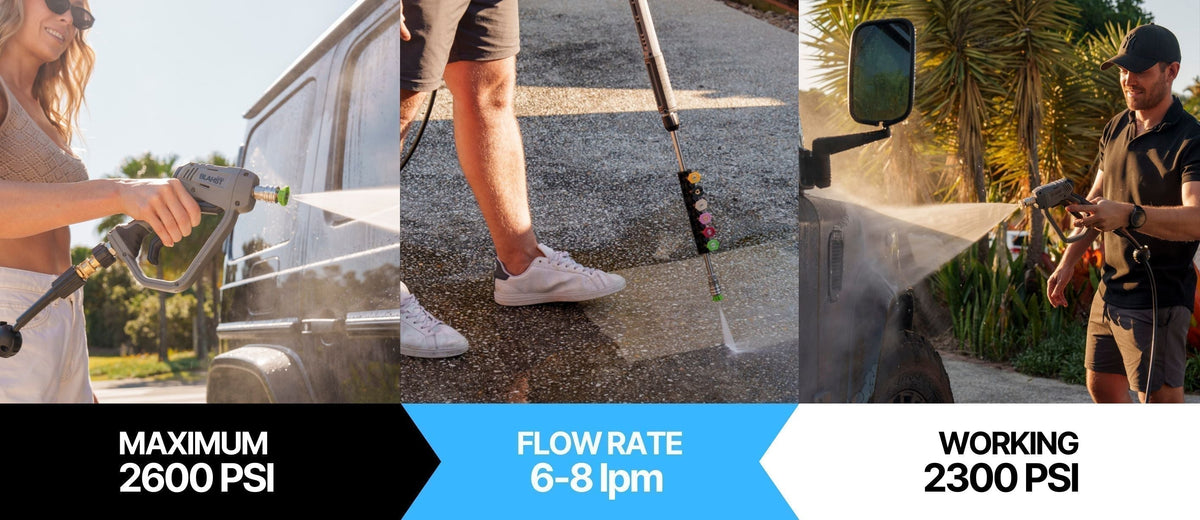
The R30 Wall-Mounted Pressure Washer is rated at 2300 PSI working pressure and 2600 PSI maximum, above the 2,000 PSI ceiling. For a vehicle, BLAHST's FAQ adds a nozzle rule to that ceiling: no quick-connect nozzle under 15 degrees. Used that way, at 30 cm, the R30 rinses a car with a wide fan, and the same unit handles the driveway and paths afterwards.
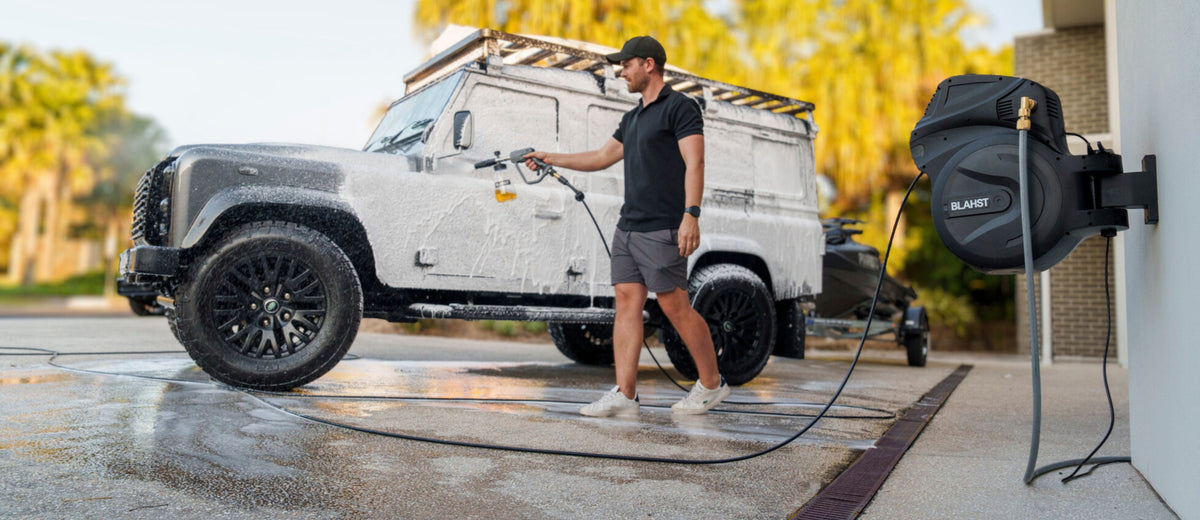
On a car, the difference the R30 makes is reach. Its 30 metre retractable hose reaches right around a car, 4WD, boat or caravan without moving the unit, so the distance rule holds on the far side of a dual-cab as easily as the near side. "Love the extra long retractable hose, reaches around my cars and caravan no problem." (Verified on-site reviewer, R30 Wall-Mounted Pressure Washer) The unit stays mounted on the wall and the hose retracts when the wash ends, with nothing to set up or pack down.
BLAHST publishes the intended use for its wall-mounted washers as domestic and occasional light trade cleaning of vehicles, 4WDs, boats, caravans, patios, decks, paths and driveways (Warranty Policy Product Warranty Australia). For a car in a home driveway, the wide nozzle, 30 cm and a moving lance are the whole method. The washer only has to be ready when you walk out to it.


Share:
4WD underbody cleaner: how to wash under a 4WD after a trip
Why do Tyres Transform the Look of a Car when Treated Properly?