


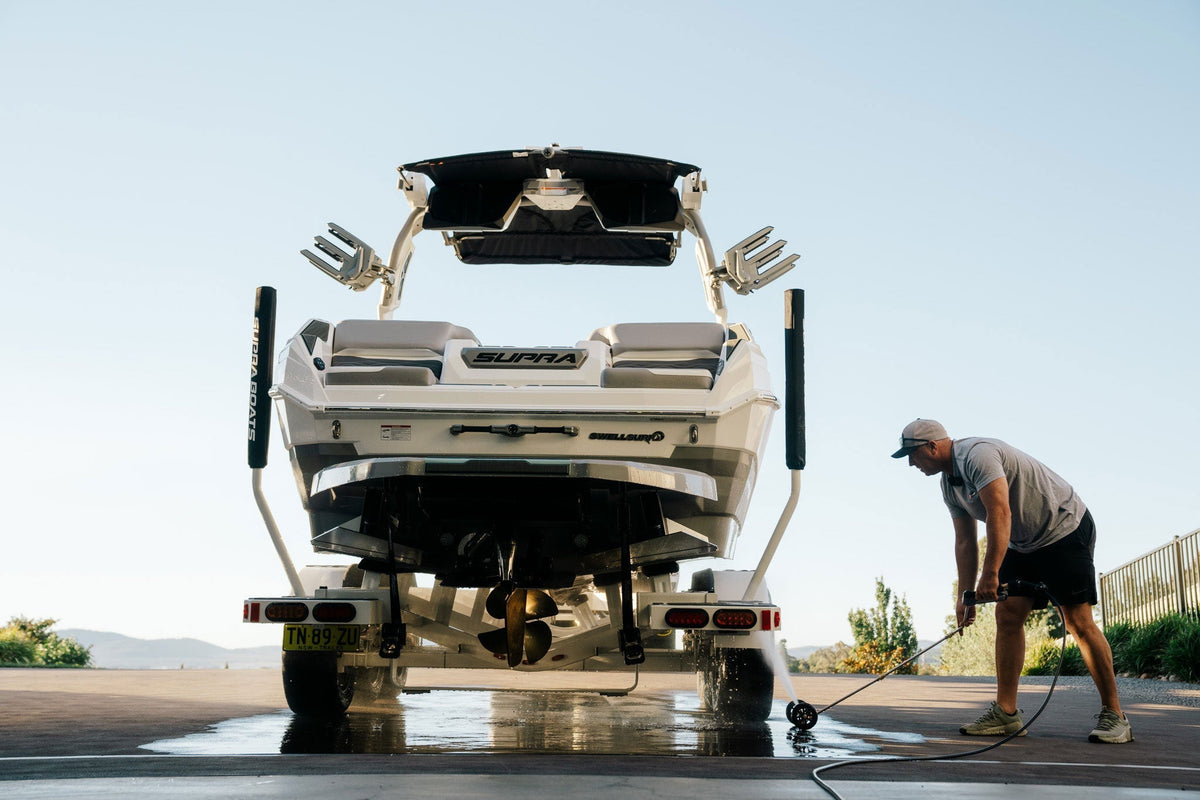
Salt left on the hull, trailer and outboard starts costing money, so the rinse happens the day the boat comes out, on the trailer, in the drive. Rinse top down with a 25 or 40 degree nozzle, foam the hull, rinse the trailer and brakes, then flush the outboard with a garden hose the way its manual says. Never fit a nozzle under 15 degrees on the boat.
What you need
- A pressure washer with 25 and 40 degree nozzles.
- A foam cannon.
- BLAHST Marine Salt Wash Concentrate 1L.
- A soft-bristle brush on a pole and a bucket.
- A garden hose, plus the flush fitting or muffs your outboard maker specifies.
- A Microfibre Drying Towel or a blower.
Step 1: Rinse the salt off, top down
Rinse the whole boat from the top down with the 40 degree nozzle: canopy or windscreen, deck and gunwales, then the hull, then the trailer. International's Australian Boat Maintenance Guide gives the same order for a boat out of the water: start from the top and pressure wash the topsides and work your way down to the underwater hull. Keep the lance moving. On fittings and seals, step further back or change to the 40 degree tip. Never fit a nozzle under 15 degrees, and keep the jet out of the cowl vents, the transducer and any wiring.
Step 2: Foam the hull and let it dwell
Foam the hull from the bottom up so the coat is even. Marine Salt Wash is pH neutral and phosphate free, and gentle on metal, plastic, glass and polished finishes. Mix it at the dilution on the bottle. Do not foam in full sun: dried foam streaks and the salt stays put.
Step 3: Brush the waterline, then rinse again
Brush the scum line and any growth at the waterline with the soft brush while the foam is still wet, then rinse the hull top down before the foam dries. International's guide says to wash thoroughly with a recommended boat cleaner to remove dirt, salt and grime. It treats loose or flaking coatings as something to scrape back and chalky gelcoat as something to buff or polish, so keep the jet off both: pressure lifts what is already loose. Never aim the lance at a hatch seal, a through-hull fitting or the bung.
Step 4: Rinse the trailer, brakes and winch
Rinse the trailer from the drawbar back: rails, springs, brakes, winch and rollers. Keep the jet off the hub seals, and off the trailer's light plug and wiring altogether. The Australian Government's Recreation and community marine pests page tells owners of trailered boats to drain the boat, trailer and gear on land, rinse everything with fresh water and let it dry, and remove all plants and animals. Tasmania's Protecting Against Aquatic Threats page adds to wash the vessel away from shore, where it does not drain into the marine environment.
Step 5: Flush the outboard with the hose
Flush the outboard's cooling passages with fresh water from the garden hose, through the flush port or muffs, as the engine's manual describes. Yamaha Motor Australia calls flushing the engine thoroughly after each use one of the most important pieces of regular maintenance you can do to an outboard engine (How To | Flush an Outboard Engine). Suzuki Marine Australia's Service & Maintenance page says to wash the exterior body and flush the cooling water passage on your outboard motor with fresh water after each use. The pressure washer stays out of this step. Spray nothing into the air intake or the electrics.
After the wash
Dry the gelcoat and glass before water spots form, with the microfibre towel or a blower, working top down. Best way to dry a car without scratching gives the order. Leave the bungs out and let the trailer, ropes and gear dry before they go away.
What never to spray
BLAHST's FAQ advises against any quick-connect nozzle under 15 degrees on a vehicle, and the same floor applies to a boat. On gelcoat, use the 25 and 40 degree tips only, and never the turbo nozzle, which is a zero degree stream. Never aim the jet at the cowl intake, wiring, the transducer, hatch or window seals, or the fuel filler. Never spray people or animals. Never work from a ladder with the lance.
Frequently asked questions
What is the recommended PSI for pressure washing a boat?
There is no published figure to work to: International's Australian boat maintenance guide gives no PSI for gelcoat. What protects gelcoat is the nozzle and the distance: a 25 or 40 degree tip, the lance moving, and more distance on fittings and seals. The R30 is rated 2300 PSI working and 2600 PSI maximum, and on a boat that output is controlled by the nozzle and distance, not by the rating. What PSI pressure washer is safe for a car? explains the same principle on paint.
Can I wash my boat at a car wash?
A self-serve bay that takes a trailer can rinse the hull and trailer, but it cannot flush the outboard, and the boat still has to dry. Both happen at home, so the whole wash is simpler in the drive.
Washing a boat on the trailer from one mount
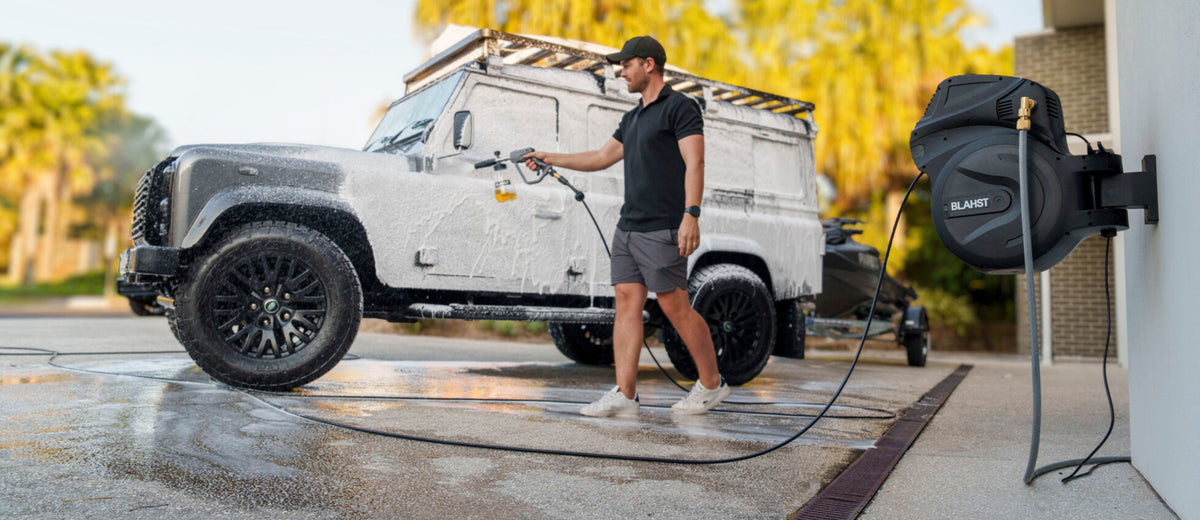
BLAHST's R30 has a 30 metre hose that reaches right around a car, 4WD, boat or caravan without moving the unit. The washer stays on the garage wall and the hose retracts when the wash is done. It is rated 2300 PSI working and 2600 PSI maximum, and it is made for domestic use and occasional light trade on vehicles, 4WDs, boats, caravans, patios, decks, paths and driveways. For the boat and trailer above, that is the R30 Wall-Mounted Pressure Washer.


Share: