


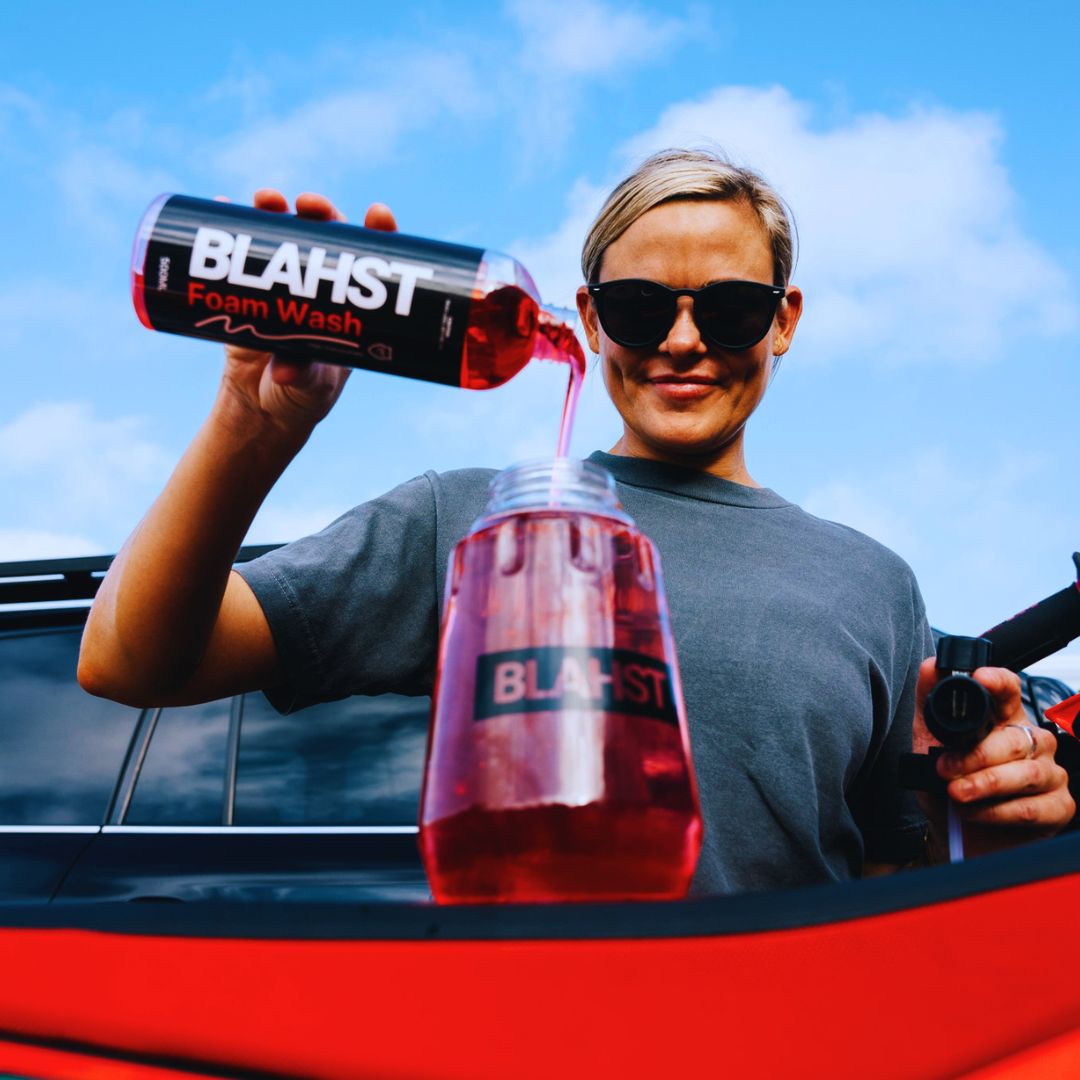
A pH neutral car wash concentrate made for a foam cannon, mixed at the ratio on its label and run through a cannon on a pressure washer. The thickness comes from the mix and the cannon; the safety comes from the chemistry. A neutral formula lifts dirt and lubricates the panel without dissolving the wax, sealant or coating underneath.
Three things set the result on the driveway: the product's chemistry, the dilution and the water it is mixed with, and the cannon and washer pushing it. Each is covered below, along with how weather changes foam and what makes the contact wash afterwards safe.
Why does foam thickness matter during a car wash?
Thick foam stays on the panel long enough to work. Foam that clings gives the detergent time to wet and loosen road film before anything touches the paint, and it carries loosened grit down the panel as it slides. The useful window is while the foam is still wet: foam that has run off cannot dwell, and foam that has dried has stopped working and started leaving residue.
Thin foam runs off in seconds, so the detergent is gone before it has softened anything. What thick foam does not do is scrub. It reduces what is on the paint when the mitt arrives, which is the point of a pre-wash.
What determines the thickness of snow foam?
Four things: the product, the dilution, the cannon, and the water. A concentrate made for a cannon carries surfactants that hold air in a stable foam; a shampoo made for a bucket does not, however much of it goes in the canister. Dilution sets how much surfactant is in each litre sprayed, so an over-diluted mix foams thin.
The cannon does the aerating. Water from the washer passes an orifice and draws the mix up from the canister, and air is folded into the stream on the way out. The orifice size and the washer's pressure and flow decide how much air is mixed in, so the same bottle can foam thick on one setup and runny on another. Adjust the cannon's mix dial before blaming the product.
Water hardness works against foam. Hard water carries dissolved calcium and magnesium, and those minerals bind with surfactant molecules before the surfactant can form foam. On hard water the same mix foams thinner, and the same minerals dry into spots if the rinse is left to evaporate. Thickness is not cleaning, though: a dense foam with little active cleaner clings well and lifts little, so judge the foam by what rinses off, not by how it looks on the bonnet.
What makes a foam wash solution safe for paint and coatings?
pH neutral chemistry and lubrication. Wax, sealant and ceramic coatings are protective films, and strong alkaline degreasers and all-purpose cleaners are formulated to dissolve oils and films. A neutral car wash is formulated to loosen dirt and leave the film underneath alone. BLAHST publishes its position on its FAQ: its chemical range is pH neutral and designed to be safe on vehicle coatings and paint.
The same rule covers a ceramic-coated car. A coating is a cured film on top of the clear coat, and a cleaner formulated to dissolve films does not distinguish between a wax and a coating. Use a pH neutral foam, and let the coating maker's own care guide set any further limits.
Lubrication is the second half. A slippery foam lets grit slide off the panel as the foam drains, instead of sitting where a mitt will drag it. BLAHST's Foam Wash is built on that mechanism: a thick, lubricating foam that lifts dirt so it drips away instead of being dragged across the paint.
How do you dilute foam wash for a foam cannon?
At the ratio on the label, mixed in the canister before it goes on the cannon. Labels differ by product, so use the one on the bottle. BLAHST's Off-Road 4x4 Foam Wash Concentrate, for example, is published at 10:1 through a foam cannon with a 60 second dwell before rinsing.
Too much water and the foam runs off before it has worked. Too much concentrate wastes product and can leave a film that needs a second rinse. Mix to the label, and if the foam still runs thin, check the cannon's dial and orifice before adding concentrate.
How does weather affect snow foam on the car?
Heat and wind dry the foam before it has worked. Hyundai's Australian IONIQ 5 2023 Owner Manual tells owners not to wash the vehicle "in direct sunlight or when the body of the vehicle is warm." Dried detergent leaves a film that has to be washed off again, and on a warm panel it can mark the paint.
On a hot day, foam in the shade or early, cool the panels with a rinse first, and work one side at a time so the foam is rinsed before it goes tacky. In wind, foam the side of the car the wind is blowing onto, so the foam is pushed onto the panel rather than off it. Cool mornings are easier: the foam stays wet for the full dwell on the label.
How do you apply snow foam for the best results?
Rinse the loose grit off first, then foam from the bottom up, let it dwell, and rinse from the top down. The rinse-first step is the order What PSI pressure washer is safe for a car? sets out: foam laid over grit only holds the grit against the paint until a mitt drags it.
Bottom up because foam runs downhill. Applied from the roof first, it streams over panels you have not foamed yet and collects in thicker bands low on the car. Start at the sills and work up, and each panel gets an even layer.
Bottom up also gives the sills and lower doors, where the heavy dirt is, the longest dwell. Rinse top down with a wide nozzle so the loosened dirt and the foam run off panels you have already rinsed. On a vehicle BLAHST's FAQ rule applies to the rinse: no quick-connect nozzle under 15 degrees.
What makes a foam wash safe for contact washing afterwards?
Lubrication left on the panel, and less grit for the mitt to meet. Foam that lifts and drains carries grit off the paint; foam that has dried has glued it there. After the rinse, the contact wash is a lubricated mitt over paint that is already mostly clean, which is how a hand wash reduces the risk of swirl marks.
Two bucket habits keep it that way. A wash bucket with a grit guard traps dirt at the bottom so the mitt is less likely to pick it up again, and the mitt is rinsed in a second bucket before it goes back in the wash mix. Then dry before the water evaporates. Best way to dry a car without scratching covers the drying end, including why a towel dragged over remaining grit is where most swirls come from.
Common snow foam mistakes
Foaming a dirty, dry car in full sun. The foam dries in minutes and dried detergent marks paint. Rinse the grit off, work in the shade.
Using dishwashing liquid or a degreaser. Both are made to strip oils and films, and a wax or sealant is a thin protective film.
Expecting foam to replace the mitt. Foam is a pre-wash. It reduces what the mitt meets; it does not remove bonded road film on its own.
Fixing thin foam with a stronger mix without checking the cannon. A blocked or misadjusted orifice makes thin foam whatever is in the canister. Rinse the cannon after every wash.
Rinsing foam off with the 0 degree tip or a turbo nozzle. Neither goes near a vehicle. BLAHST's FAQ bars any quick-connect nozzle under 15 degrees on a vehicle, and the rotating turbo nozzle is a 0 degree tip for driveways and paths.
Frequently asked questions
Can you use normal car shampoo in a foam cannon?
Yes, but it will foam thin. A shampoo made for a bucket is formulated to lubricate and rinse clean, not to hold air, so most of it runs straight off the panel. A concentrate made for a foam cannon carries foaming surfactants and a label ratio for the canister.
How long should snow foam sit on the car?
As long as the label says, and never until it dries. Labels give their own figure: BLAHST's Off-Road 4x4 Foam Wash Concentrate publishes a 60 second dwell before rinsing. Either way, rinse before the foam starts to dry, and in hot or windy weather that means sooner.
Do you need a pressure washer for snow foam?
For thick snow foam, yes. A foam gun on a garden hose mixes air at tap pressure and makes a wetter, thinner foam that slides off sooner. A foam cannon on a pressure washer forces the mix through an orifice under pressure and folds far more air into it, which is what makes foam that clings.
Choosing a foam wash for a foam cannon at home
Pick a concentrate that is pH neutral, made for a cannon and published with the mechanism it relies on. Foam Wash 1L Premium Car Wash Concentrate is BLAHST's car wash concentrate for hand washing or a foam cannon. BLAHST publishes it as pH neutral and designed to be safe on vehicle coatings and paint, and it makes a thick, lubricating foam that lifts dirt so it drips away instead of being dragged across the paint. That is a mechanism, not a promise: the foam reduces what the mitt meets, and the rinse and the drying still decide the finish.
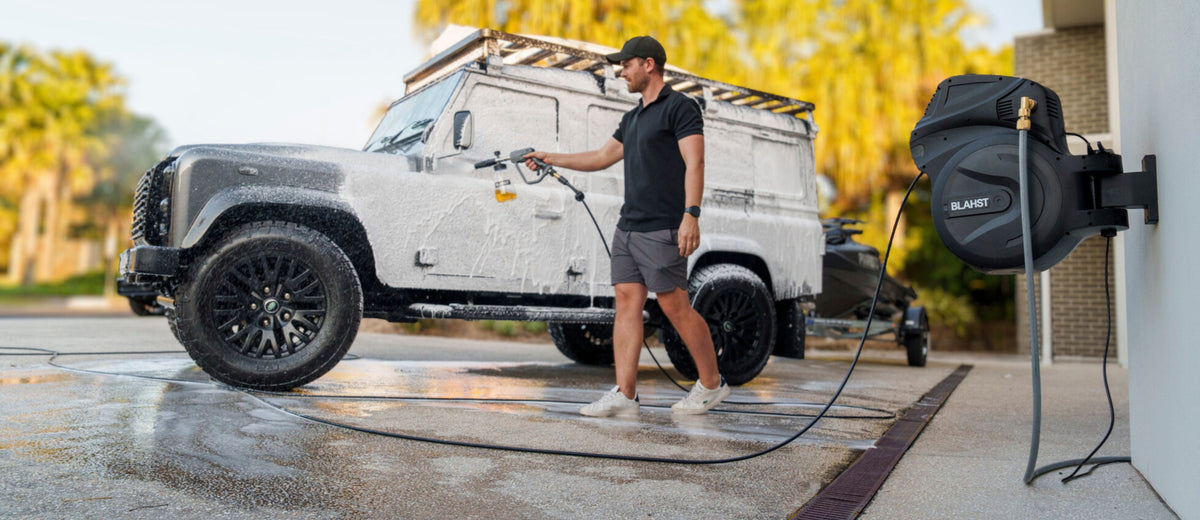
On the washer side, BLAHST's R30 ships foam cannon ready with its trigger gun, so a cannon clips onto the gun's quick connect; the foam cannon itself is a separate item. What the wall-mounted unit removes is the setup and pack-down tax: dragging a washer out, unrolling hoses and leads, then packing it all away again, which turns a fifteen-minute foam wash into a job that gets put off. The unit stays mounted with the hose retracted, so a foam wash on a Sunday arvo starts at the car rather than at the shed door.
Whatever the bottle, the routine is the one above: rinse the grit, foam bottom up, dwell without drying, rinse top down with a wide nozzle, then dry.


Share:
How to store a pressure washer between washes
Pressure washer accessories for car detailing: which ones matter?