


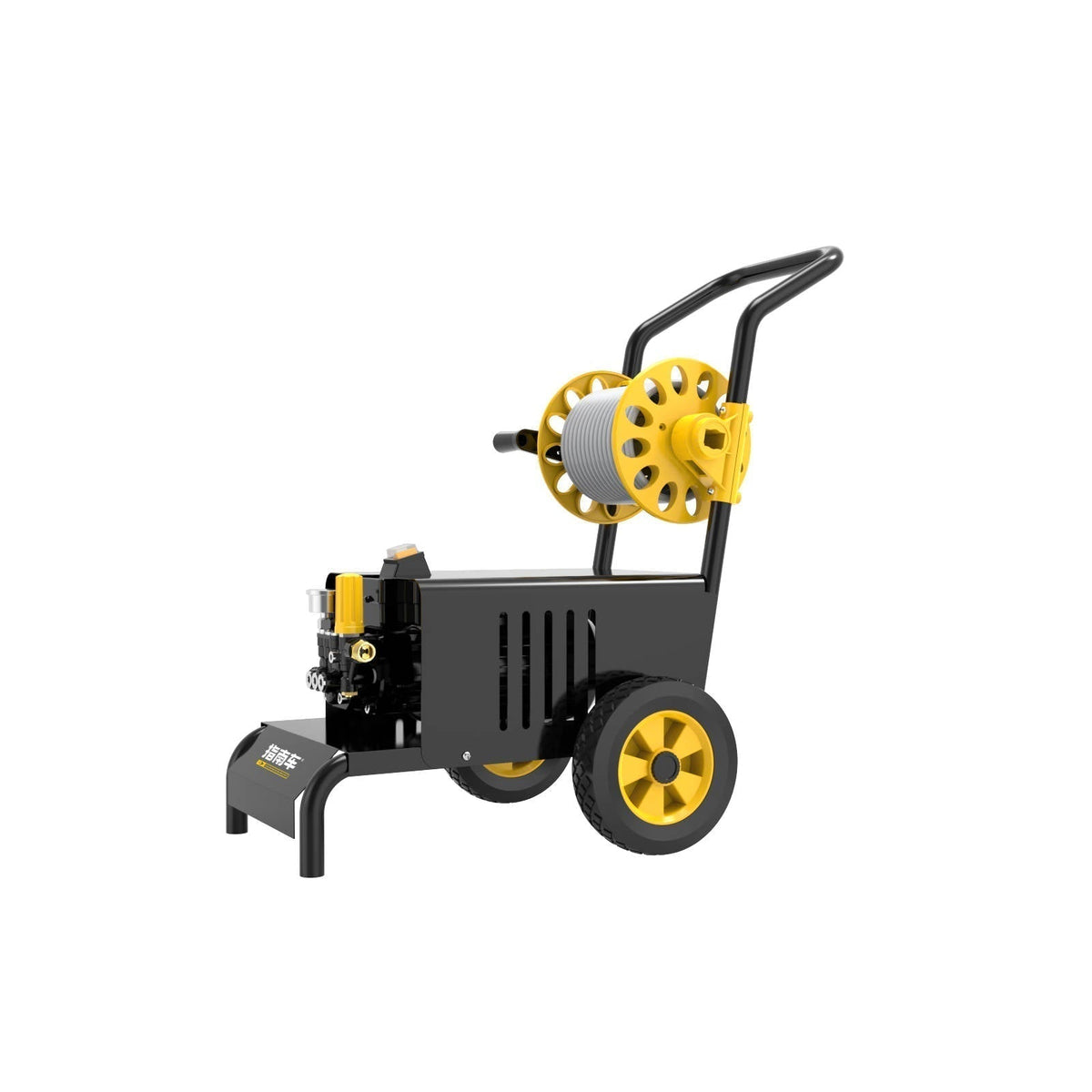
An electric pressure washer is the right choice for a home with a power point within reach of the job. That covers cars, 4WDs, a boat on the trailer, decks, paths and the driveway itself. A petrol pressure washer is the right choice where there is no power to plug into, or where the job is a large hard surface a long way from the nearest outlet. Both are pressure washers. The difference is what drives the pump: a mains-powered electric motor or a small petrol engine.
The choice turns on three things: how far the job sits from a power point, how large and how dirty the surface is, and whether the machine will live in a garage or on the back of a ute.
Are petrol pressure washers better than electric?
Better at two things, and worse at most others. A petrol pressure washer runs anywhere fuel can be carried, so it suits a stockyard, a shed with no power, or a trailer-mounted unit that follows machinery around a property. Its engine can also drive a larger pump than a household power point can feed, so a petrol unit can carry more output than a plug-in one.
At home that advantage rarely gets used. A car, a 4WD after a beach run, a boat on the trailer, a deck or a driveway all sit within a hose length of the house. An electric washer cleans them with no fuel to buy, no engine to service and no exhaust.
Are electric pressure washers strong enough for outdoor cleaning?
Yes, for the surfaces around a house: vehicles, decks, paths, patios, fences and driveways. Cleaning power comes from pressure and flow working together, and the nozzle decides how tightly that output hits the surface. A 15 degree nozzle puts the pump's whole output onto a narrow band for caked mud in a wheel arch; a 40 degree nozzle spreads the same output wide for paint and timber.
Electric units fall short on scale. A commercial yard or a long shed floor takes a machine with more flow, run for hours, often fed from a tank rather than a tap. Which figures matter is the subject of Is an Electric Pressure Washer Powerful Enough for My Home and Car?.
Which is better for washing cars, an electric or petrol pressure washer?
Electric, for most homes. BLAHST's FAQ puts the limit for washing a vehicle at 2,000 PSI, with no quick-connect nozzle under 15 degrees. Any washer above that figure, petrol or electric, is run on paint with a nozzle of 15 degrees or wider, so a petrol unit's extra output buys nothing on a car. An electric unit can also run in the garage where the car is parked, which a petrol unit never should.
On paint, the variables that matter are the nozzle angle and the distance from the panel. What PSI pressure washer is safe for a car? sets both out.
What do petrol and electric pressure washers cost to run and maintain?
An electric washer costs the power it draws while the trigger is pulled, plus a nozzle or a hose seal now and then. A petrol washer costs fuel, engine oil and a service schedule. Honda's GX120, GX160, GX200 Owner's Manual for its small engines tells owners to check the engine oil level and the air filter before each use, and to change the oil after the first 20 hours. Its schedule then covers the air cleaner, sediment cup, spark plug, spark arrester, idle speed, valve clearance, combustion chamber, fuel tank and filter, and fuel tube.
None of that is a fault of petrol engines. It is what owning one involves, and an electric washer skips it. The same manual adds a fuel rule: petrol is highly flammable and explosive, so the engine is stopped and left to cool before refuelling.
On a rural block the sums change only where the job is out of reach of power. A tank-fed petrol unit on the back of a ute earns its upkeep at a machinery shed with no outlet. Near the house, the electric unit needs neither fuel nor a service schedule.
Are electric pressure washers safe?
Yes, with two habits: keep the plug, the lead and the switch out of the spray, and never aim the lance at a person, an animal, an electrical fitting or the switchboard. A mains-powered washer belongs on a power point with a safety switch behind it, and the lead stays clear of the puddle.
The safety question that catches people out runs the other way. A petrol engine's exhaust contains carbon monoxide, which NSW Health's Carbon monoxide safety fact sheet describes as a gas you cannot see, smell or hear. Its rule is plain: do not use items with petrol engines inside your home or garage, even with doors or windows open, and it lists pressure washers by name. The ACCC's Carbon monoxide safety page extends the list of places to enclosed patios, sheds and caravans. Honda's manual says the same of its engines: exhaust collects rapidly in an enclosed area such as a garage, and the engine stays at least 1 metre from buildings while it runs.
Are electric pressure washers loud?
Loud enough to wear ear protection. CHOICE's How to get the most out of a pressure cleaner measured the electric and battery pressure cleaners in its test at around 80 decibels. CHOICE puts the level that causes hearing damage during repeated or lengthy exposure at 85 decibels, and recommends earmuffs or earplugs.
A petrol washer adds engine noise on top of the pump. The engine runs the whole time the machine is on, not only while the trigger is pulled, which matters in a suburban driveway on a Sunday morning.
Electric and petrol pressure washers compared
| Electric pressure washer | Petrol pressure washer | |
|---|---|---|
| What drives the pump | A mains-powered motor, plugged into a power point | A small petrol engine, fuelled on site |
| Where it can run | Anywhere the lead reaches, including a garage | Outdoors only: never inside a home or garage, even with doors open (NSW Health), or in a shed or enclosed patio (ACCC) |
| Routine upkeep | No engine: nozzles, seals and the hose | Engine oil, air filter, spark plug and fuel system on a schedule (Honda owner's manual) |
| Noise | Around 80 decibels in CHOICE's test of electric and battery models; ear protection recommended | Pump noise plus a running engine |
Table sources: the NSW Health, ACCC, Honda and CHOICE pages linked above, fetched 14/09/2026.
Common mistakes when choosing between electric and petrol
Buying petrol for output a car cannot use. BLAHST's FAQ caps vehicle washing at 2,000 PSI, so any extra pressure is turned down by nozzle choice from the first wash.
Running a petrol unit in the garage with the door up. NSW Health's rule is no petrol engines inside a home or garage even with doors or windows open, and it warns that carbon monoxide trapped inside can build up to dangerous levels.
Judging an electric washer by its PSI figure alone. Flow carries dirt off the surface and pressure breaks it loose. A machine needs both, and the nozzle sets how concentrated that output is on the concrete.
Sizing for the one big job a year. A car needs washing most weeks and the paddock shed once a year. Buy for the weekly job and hire a petrol unit for the day.
Frequently asked questions
Do electric pressure washers work?
Yes. An electric motor drives a pump just as a petrol engine does, and the pump is what raises the water pressure. The difference is where the power comes from and how much of it a household power point can supply.
Is an electric pressure washer strong enough for stripping grime off brick walls, or do I need petrol?
For the walls of a house, an electric washer with a 25 degree nozzle lifts dirt, moss and cobwebs from face brick and render. Old, soft brick and mortar joints can be damaged by any pressure washer, petrol or electric, so test a low patch first and keep the lance moving. Work from the ground with an extension lance, never from a ladder.
Are electric pressure washers worth it?
For a home, yes. There is no fuel to buy, no engine to service and no exhaust, and a unit that plugs in can be mounted where the car is parked. Reviewers of wall-mounted units describe the alternative as dragging equipment out and packing hoses and leads away each time, the step that turns a fifteen-minute wash into a job that gets put off.
Is a battery pressure washer enough for muddy bikes and a small patio?
For a muddy bike, yes. For a patio or a car, a mains-powered washer is the tool. A battery unit trades pressure for portability: BLAHST's P440 draws its own water from a bucket, container, pond or lake with no tap connection, and is rated to 440 PSI maximum.
Choosing an electric washer that stays on the wall
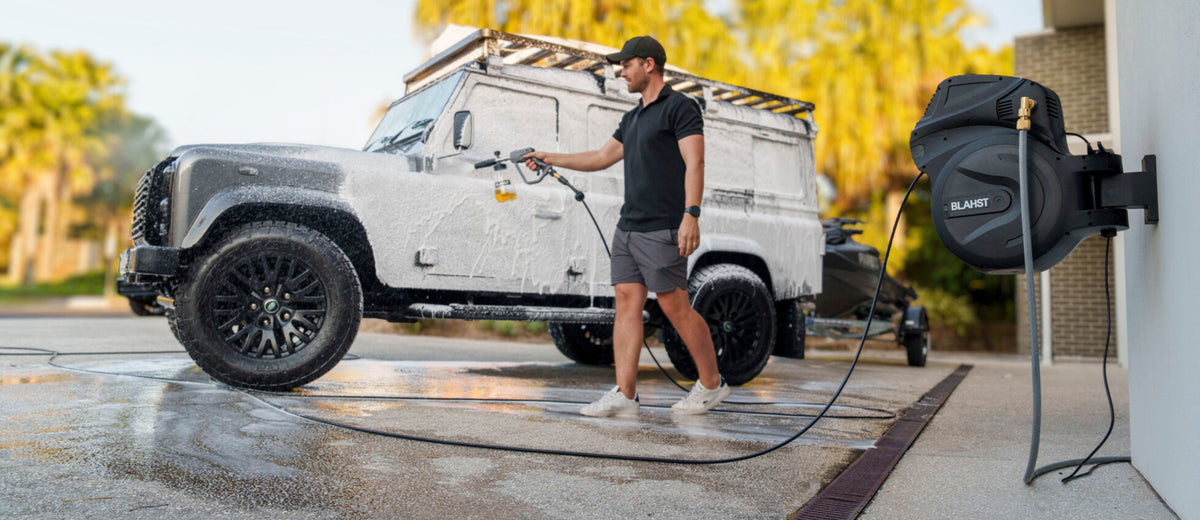
BLAHST sells electric pressure washers only, and its mains-powered R18 and R30 mount on a garage or shed wall. For the jobs this guide puts on the electric side (cars, 4WDs, boats, caravans, patios, decks, paths and driveways) that is the point. The unit stays mounted, the hose retracts after the wash, and there is nothing to set up or pack down and no fuel to fetch.
Two mounted sizes cover those jobs. The R18 is sized for vehicle washing and lighter domestic cleaning. The R30 Wall-Mounted Pressure Washer is the step up for hard surfaces, rated at 2300 PSI working pressure and 2600 PSI maximum. Both figures sit above the 2,000 PSI ceiling the FAQ gives for vehicles, so on a car the R30 is run the way the FAQ says: a quick-connect nozzle of 15 degrees or wider, never narrower. Its 30 metre retractable hose reaches right around a car, 4WD, boat or caravan without moving the unit.
The published intended use for both mounted washers is domestic and occasional light trade cleaning of vehicles, 4WDs, boats, caravans, patios, decks, paths and driveways (Warranty Policy Product Warranty Australia). That is the electric side of this comparison. A yard that needs a tank-fed petrol unit is a different job, and neither BLAHST washer is sold for it.


Share:
What is the best PSI for a pressure washer?