


Yes. An electric pressure washer plugged into a household power point cleans a car, a 4WD, a deck, a fence, pavers and a driveway. Where it stops is scale: a large hard surface a long way from power, or grime that has sat for years, wants more flow for more hours than a plug-in unit gives.
How good it is on any one job comes down to three things: how the pump's pressure and flow work together, which nozzle or attachment puts that output onto the surface, and whether the hose reaches the job without moving the machine.
Are electric pressure washers strong enough for cleaning cars?
Yes, and paint is the one surface where extra output buys nothing. BLAHST's FAQ puts the ceiling for washing a vehicle at 2,000 PSI and bars any quick-connect nozzle under 15 degrees on a vehicle. What a car needs from the washer is enough flow to rinse foam and grit off a panel in one pass, a 25 or 40 degree nozzle, and a hose long enough to keep the lance at the car maker's distance on all four sides.
The nozzle angle, the distance and the PSI ceiling on paint are set out in What PSI pressure washer is safe for a car?.
Can electric pressure washers handle driveway cleaning effectively?
Yes for everyday grime, dust and tyre marks, with the right attachment on the lance. CHOICE's How to get the most out of a pressure cleaner names the rotary nozzle, also called a turbo nozzle, as the attachment for heavily soiled areas such as footpaths and driveways. BLAHST's Pressure Washer Turbo Nozzle is that tool: a rotating zero degree stream rated to 3600 PSI for stubborn stains, algae and moss, and it is never used on vehicle paint.
For a whole slab, a surface cleaner does the even work. BLAHST's Floor & Surface Cleaner runs a 12 inch dual-nozzle cleaning path that covers driveways, patios, decks and garage floors faster than a standard lance nozzle, with a bristle skirt that reduces splash-back. It is rated to 2500 PSI, so check that figure against your washer's maximum before fitting it.
Is an electric pressure washer enough for decks, fences and outdoor furniture?
Yes, and on timber the risk is too much, not too little. Timber is soft. A narrow jet, or a wide one held close, lifts the grain and cuts a groove that shows once the deck dries. Use the fan nozzle, start at the distance CHOICE gives for a spot test, about a metre, and move closer only until the dirt lifts. Work along the boards, not across them, and keep the lance moving.
Painted fences and furniture take the same fan nozzle with the same caution. CHOICE names the fan nozzle for large areas that are not too dirty, such as the painted walls of a house, and warns that its tighter setting can strip paint if used too close.
Can an electric pressure washer clean brick, render and tiled patios?
Yes, from the ground and from the top down. CHOICE's method for walls is to start at the top and work down to avoid streaking, and never to use a ladder for hard-to-reach places: an extension lance does the reach.
Start with the fan nozzle at the metre CHOICE gives for a spot test, on a low corner, because soft old brick and loose mortar give way under a close jet from any washer. Tiled patios take the fan nozzle or a surface cleaner.
Can an electric pressure washer strip paint or damage surfaces?
Yes. CHOICE's buying guide says all models are capable of removing paint rather than cleaning it, especially where the paint is already damaged or flaking, and that the pencil nozzle's concentrated stream can damage the surface being cleaned. The damage comes from how tightly the water lands and how long it stays there: the nozzle and your hand, not the label on the box.
The pencil and turbo tips go on concrete and paths only, never on a vehicle, timber or render.
| Job around the home | Nozzle or attachment | What sets the result |
|---|---|---|
| Car, 4WD, caravan | 15 degrees or wider (BLAHST FAQ); 25 or 40 degree on panels | The 2,000 PSI vehicle ceiling (BLAHST FAQ), nozzle angle and distance |
| Driveway, path, garage floor | Rotary (turbo) nozzle for heavily soiled areas (CHOICE); surface cleaner rated to 2500 PSI, checked against the washer's maximum (BLAHST) | Repeated passes on old stains; a second pass clears the rotary nozzle's circular marks (CHOICE) |
| Timber deck, painted fence, furniture | Fan nozzle (CHOICE) | Distance and a moving lance; the tight setting strips paint if used too close (CHOICE) |
| House walls, brick, render | Fan nozzle, top down, extension lance from the ground, never a ladder (CHOICE) | Soft brick and mortar joints spot tested first |
Table sources: BLAHST's FAQ and Floor & Surface Cleaner page, and the CHOICE buying guide linked above, all fetched 14/09/2026.
What makes a good electric pressure washer for home use?
One that pairs its pressure with enough flow, ships with a set of nozzles, and reaches the whole job from where it lives. Pressure (PSI) breaks dirt loose; flow (litres per minute) carries it off the surface. The models in CHOICE's test used about 2 to 8.5 litres per minute, and a high PSI figure with a thin flow behind it hits hard and rinses slowly.
Look for:
- A nozzle set from 15 to 40 degrees, with the 0 degree or turbo tip kept for hard surfaces only.
- An automatic cut-off that stops the pump when the trigger is released. CHOICE lists it as a safety feature that also saves energy and wear.
- A hose long enough to walk around the vehicle without dragging the unit. CHOICE says a long hose makes a unit easier to use.
- A lead that reaches a power point with a safety switch, and a place to keep the machine that does not involve unpacking it. CHOICE counts onboard storage as a feature; a wall mount does the same job.
Where electric pressure washers fall short
No power point within reach. The lead sets the range, and a paddock shed, a stockyard or a boat ramp can sit beyond it. Electric vs petrol pressure washer: which suits your home and car? covers the petrol decision for those jobs.
Serious soiling over a large area. A plug-in unit is built for the jobs around a house. For a lot of ground-in dirt, CHOICE suggests hiring a more powerful commercial or industrial machine, or paying a professional.
Battery units on anything but small jobs. CHOICE found battery life lasts long enough for small cleaning jobs and operating pressure is generally not as great as mains-powered models.
Frequently asked questions
What PSI should an electric pressure washer have?
Enough for the hardest surface you clean often, and no single figure decides paint safety on its own. On a vehicle, BLAHST's FAQ gives a ceiling of 2,000 PSI and a nozzle of 15 degrees or wider. For decks, pavers and driveways, What is the best PSI for a pressure washer? sets out how to choose by surface and nozzle, since Australian guidance gives no PSI figure for those surfaces.
Is an electric pressure washer good enough for car detailing at home?
Yes. A detailing wash at home runs on a foam cannon, a nozzle of 15 degrees or wider and a steady stream, and an electric washer on a household power point runs all three. Keep the pencil and turbo tips off the car. Daily paid detailing is a different use category: BLAHST's wall-mounted washers are sold for domestic and occasional light trade use, not for mobile detailing.
Is a cordless pressure washer any good?
For small jobs away from a power point, yes, with less pressure than a mains-powered model. BLAHST's P440 draws its own water from a bucket, container, pond or lake with no tap connection and is rated to 440 PSI maximum, which puts it at small rinses away from a tap, not a driveway.
Do I need a pressure washer at all?
For an occasional job, no. CHOICE puts consumer-grade hire at around $60 to $200 a day for a few small jobs, and calls a bucket and scrubbing brush the most environmentally friendly option. Its line on buying is that owning one is worth it for regular use, or for washing a car.
Choosing an electric washer for the jobs above
BLAHST sells electric pressure washers only: the cordless P440 and two mains-powered wall-mounted sizes. The R18 is sized for vehicle washing and lighter domestic cleaning. The R30 Wall-Mounted Pressure Washer is the step up for hard surfaces, rated at 2300 PSI working pressure and 2600 PSI maximum. Both figures sit above the FAQ's 2,000 PSI vehicle ceiling, so on a car the R30 runs with a quick-connect nozzle of 15 degrees or wider, never narrower.
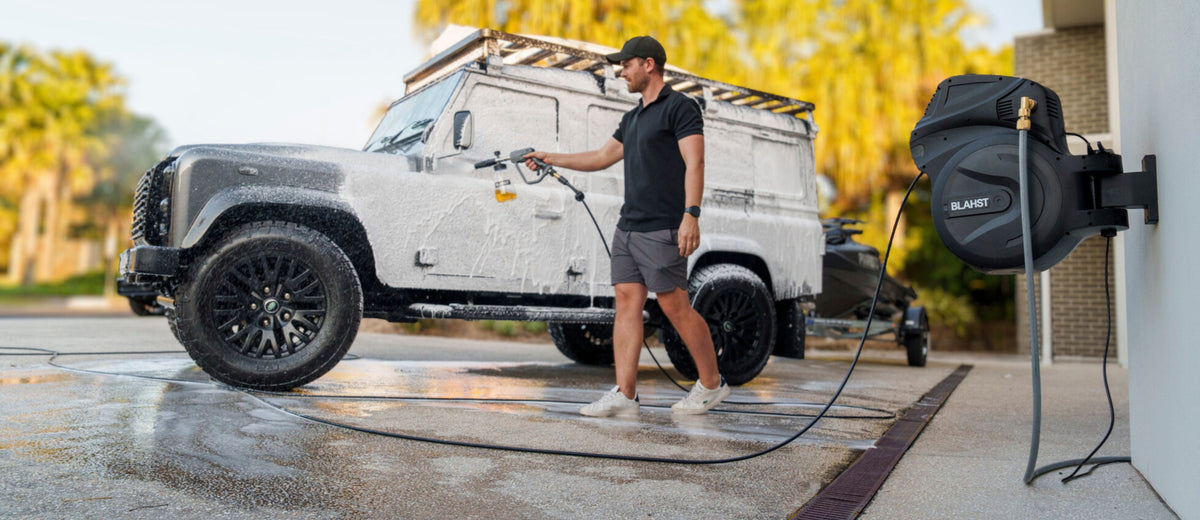
On a car, reach matters as much as pressure, and the R30's 30 metre retractable hose reaches right around a car, 4WD, boat or caravan without moving the unit. The washer stays on the wall, the hose retracts when the wash ends, and nothing is set up or packed down.
The published intended use for both wall-mounted washers is domestic and occasional light trade cleaning of vehicles, 4WDs, boats, caravans, patios, decks, paths and driveways (Warranty Policy Product Warranty Australia). Cars, decks, paths and driveways, the core of this guide, are on that list.


Share:
How Do I Clean My Driveway Using a Pressure Washer Surface Cleaner?