


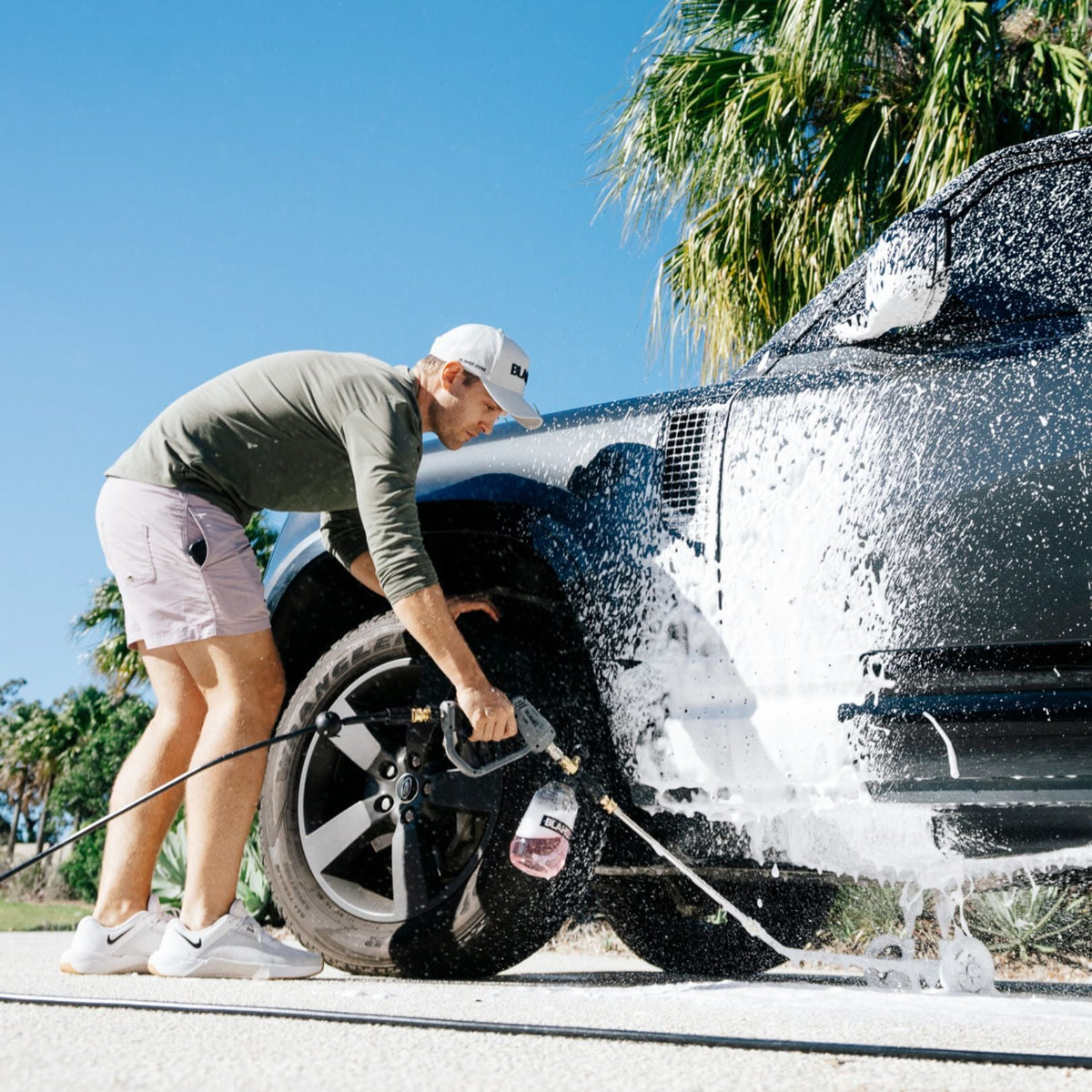
A 4WD underbody cleaner is an attachment that puts foam and water under the vehicle where a lance held from the side cannot reach. That means the chassis rails, crossmembers, diff housings and the backs of the wheel arches. The job is simple. Salt and red dust come off the underside the same day the trip ends, before they can hold moisture against bare metal.
Three things decide how clean the underside comes up: how soon you start, whether foam goes on before the rinse, and how far under the vehicle the water reaches. Each is covered below, along with what Australian car makers' manuals say about the underside and the honest place a garden hose still has in the job.
Is it a good idea to wash the underside of your car?
Yes, and two car makers say so in their Australian manuals. Tesla's Australian Model Y Owner's Manual tells owners to thoroughly rinse all traces of road salt from the underside of the vehicle, wheel wells and brakes. Its reason is plain: to avoid corrosive damage that may not be covered by the warranty. Mazda's Australian Mazda CX-30 Owner's Manual says to pay special attention to removing salt, dirt, mud and other foreign material from the underside of the wings. It also says to make sure the drain holes in the lower edges of the doors and rocker panels are clean.
Beach driving is the Australian version of a salted road. RACQ's Tips for driving on the beach says to properly clean under your vehicle as soon as practical, to remove the sand and saltwater from the underbody and avoid rust or corrosion. Salt sitting in a chassis rail does its work in the weeks after the trip, not during it, so the wash belongs on the day you get home.
Red dust asks for the same wash for a different reason. Fine dust packs into seams, drain holes and the tops of the chassis rails, and once damp it stays damp against the metal. Rinse it out while it is loose.
How to wash under 4WD?
Rinse the loose grit off, foam the underside and let it dwell, then flush the rails and crossmembers front to back until the runoff runs clear. That order matters. Grit blasted around under a dry chassis only moves; foam lifts it so the rinse can carry it away.
Start in the shade with the panels cool. Tesla's manual says not to wash in direct sunlight, and the rule holds under the vehicle: dust that dries onto a hot chassis rail sets harder than damp dust. Flush the wheel arches first, because they hold the most. Tesla has owners flush accumulations of mud from the wheel wells and panel seams before the wash proper begins.
Foam next. Off-Road 4x4 Foam Wash Concentrate runs at 10:1 through a foam cannon with a 60 second dwell before rinsing. Use it under the vehicle and in the arches. On the paint above, Foam Wash 1L Premium Car Wash Concentrate produces a thick, lubricating foam that lifts dirt so it drips away instead of being dragged across the paint. Do not let either foam dry on.
Then rinse. On the panels, the rules are the ones any car wash follows. BLAHST's FAQ advises against any quick-connect nozzle under 15 degrees on a vehicle. Tesla's manual asks for at least 30 cm between the nozzle and the surface, with the nozzle kept moving and never concentrated on one area. Under the vehicle, keep to a 15 degree or wider nozzle as well, and chase the debris out rather than in. Work front to back along each rail, then back to front, so sand leaves through the open ends instead of packing into the closed ones. Diff housings, skid plate edges, spring perches, tow points and the inside of the rear bumper hold the most. What PSI pressure washer is safe for a car? sets out the nozzle and distance rules on paint in full.
A garden hose does this job too, with a fan nozzle and a hose-end foam gun. It shifts loose sand and dissolves surface salt, and a rinse today with a hose beats a rinse next weekend with anything. A pressure washer and an underbody attachment add reach. The fan carries further under the vehicle, and the attachment puts the nozzles under the middle of the chassis, where a lance held from the side does not go.
Brakes last. Tesla's manual has owners rinse the brakes along with the underside, then dry them by going on a short drive and applying the brakes multiple times. Do the same after any beach run.
What is the best underbody cleaner for a 4WD?
The one that foams and rinses without a tool swap, reaches under a lifted 4WD, and is made for the pressure washer you own. Those three tests decide it.
Foam then rinse from one attachment. An underbody attachment that only rinses leaves the foam step to a separate cannon. BLAHST's Underbody Foam + Rinse Kit foams and rinses from the same attachment, switching between the two without swapping tools.
Reach under a lifted vehicle. A raised 4WD on tall tyres sits well above a standard car, so the attachment has to travel under it rather than poke at the sills. The kit's twin-wheel base and extension lances reach under lifted 4WDs and other raised vehicles.
Fit to the machine. The kit's yellow 15 degree rinse nozzles are made specifically for the R30, so the kit is an R30 attachment and is bought as one.
What is the best way to clean the undercarriage of my car?
For a car without a 4WD's clearance, keep the same order and give more time to the wheel arches and drain holes, because there is no room to put a lance under the middle. Mazda's manual names the two places that matter. The first is the underside of the wings, meaning the arch liners and the panels behind them. The second is the drain holes in the lower edges of the doors and rocker panels. Both trap salt and sand, and both are reachable from the side with a 40 degree nozzle.
Work each wheel arch from the tyre outward, with the front wheels turned to open the arch up. Rinse the sills from below at a low angle so water runs back out rather than up into the door bottoms. Tesla's manual says not to aim water hoses directly at window, door or bonnet seals, and that holds from underneath: rinse the sill, not the seal above it.
On a low car, the honest answer is the wheel-arch method. The Underbody Foam + Rinse Kit's twin-wheel base and extension lances are there to reach under lifted 4WDs and other raised vehicles.
Common underbody washing mistakes
Leaving it a week. RACQ's advice is as soon as practical, and Tesla's is to remove corrosive substances such as road salt immediately rather than wait for the next full wash. Salt in a rail is working the whole time it sits there.
Using the pencil jet under the car. A 0 degree tip concentrates the washer's whole output on one spot, and under a vehicle it drives sand and water into seals and wiring rather than out of them. BLAHST's FAQ rule against quick-connect nozzles under 15 degrees on a vehicle covers the underside as much as the paint.
Foaming a hot chassis. Foam that dries before the rinse leaves the dust where it was. Shade first, then foam.
Skipping the brakes. Salt sits in the calipers and backing plates after a beach run, and Tesla's manual treats the brakes as part of the underside rinse, with a short drive afterwards to dry them.
Ignoring the drain holes. Mazda's instruction to keep the door and rocker panel drain holes clear is there because a blocked drain hole holds water inside the panel.
Fitting the kit's yellow rinse nozzles to another washer. They are made for the R30, and the R30 is the machine they go on.
Frequently asked questions
How do you get red dust off a 4WD without scratching it?
Foam first, rinse from the top down, and keep the mitt off the paint until the rinse has carried the loose dust away. Fine dust dragged across a dry panel by a mitt is what leaves the scratches, so the contact wash comes after the rinse, never before. Work top down with two buckets, and rinse the mitt after each panel.
Can you wash under a 4WD with a garden hose?
Yes. A fan nozzle and a hose-end foam gun shift loose sand and rinse surface salt, and Tesla's manual starts its own wash by flushing grit off with a hose. A pressure washer adds reach under the middle of the chassis and a foam cannon adds thicker foam, but the day you do it matters more than the tool you do it with.
Can I use the Underbody Foam + Rinse Kit on another pressure washer?
The kit is made for the R30. Its yellow 15 degree rinse nozzles are made specifically for the R30 Wall-Mounted Pressure Washer, and the kit is bought as an R30 attachment. With a different washer, use the wheel-arch and hose method above.
Underbody kit for the R30
The kit that fits this job is BLAHST's Underbody Foam + Rinse Kit, made for the R30 Wall-Mounted Pressure Washer. It foams and rinses from one attachment without swapping tools. Its twin-wheel base and extension lances reach under lifted 4WDs and other raised vehicles. Its yellow 15 degree rinse nozzles are made specifically for the R30.
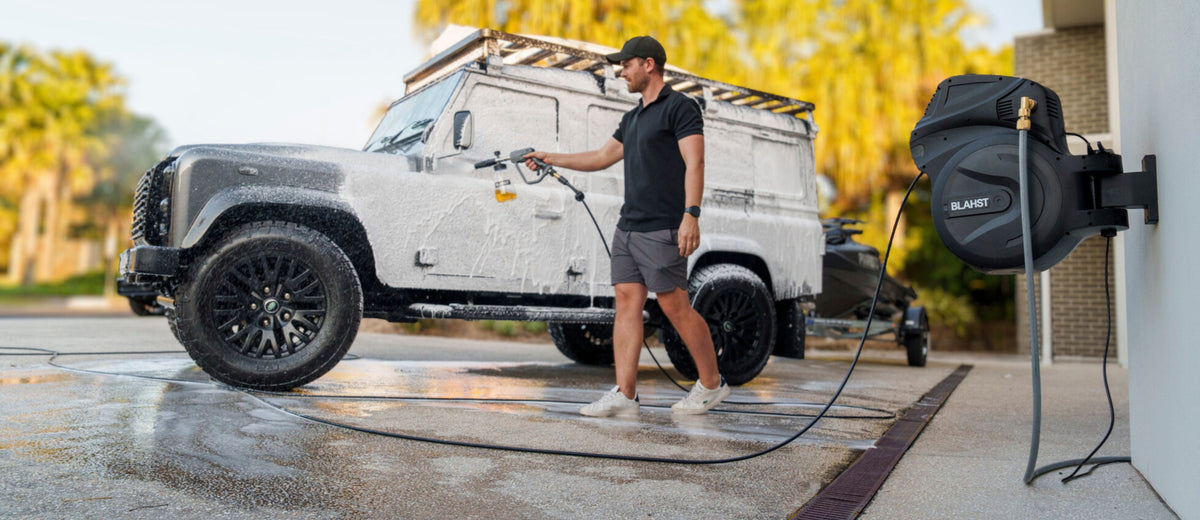
The R30 suits the rest of the wash. It is rated 2300 PSI working and 2600 PSI maximum, and on paint that pressure is managed with the nozzle: 15 degrees or wider, the floor BLAHST's FAQ sets for a vehicle. Its 30 metre hose reaches right around a car, 4WD, boat or caravan without moving the unit, so a dual-cab with a canopy is done from one mount. The R30 is made for domestic use and occasional light trade on vehicles, 4WDs, boats, caravans, patios, decks, paths and driveways, and a 4WD after a beach run sits squarely inside that.
Next: Best way to dry a car without scratching covers the drying that follows, mirror caps and rack mounts included.

Share:
What is the best PSI for a pressure washer?
What PSI pressure washer is safe for a car?