


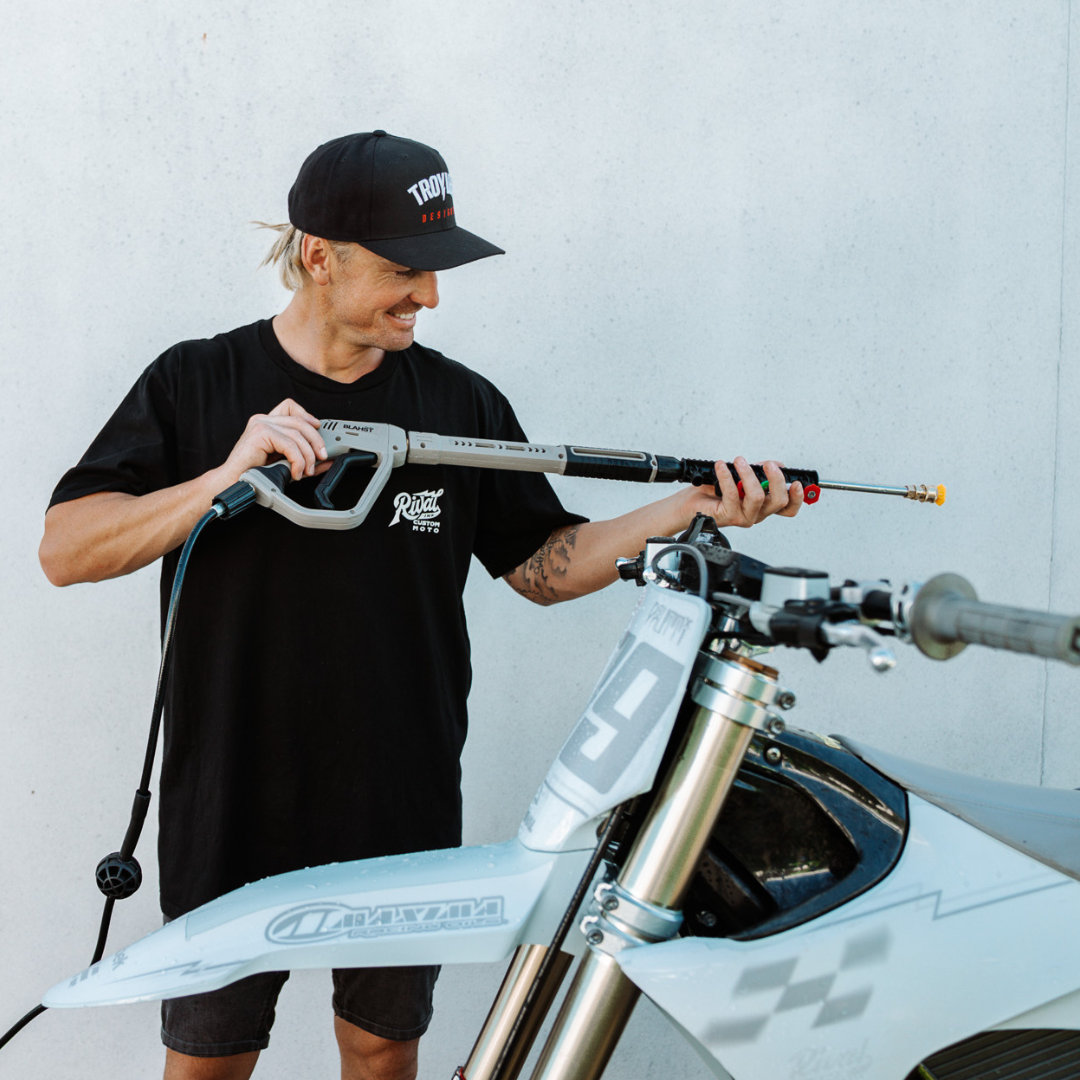
Mud comes off a dirt bike or ATV while it is still soft, so rinse it the afternoon you get home. Work from the top down with a 40 degree nozzle held at least 60 cm from the bike. Keep the jet off the bearings, seals, electrics, chain and air intake, and read your own manual first: Honda's says not to use a high-pressure washer at all.
What you need
- A pressure washer with a 40 degree quick-connect nozzle fitted.
- A foam cannon and Foam Wash 1L Premium Car Wash Concentrate.
- A soft brush, a small brush for the radiator guards, and a sponge.
- An exhaust bung or a plastic bag, and an airbox cover.
- Chain lube, a chamois or the Air Maxx Dryer, and a bike stand.
Step 1: Cool down, plug the exhaust, cover the airbox
Yamaha Motor Australia's YZ450F 2021 Owners Service Manual says to confirm the bike is completely cooled, then block or cover the air duct and muffler outlet. Check the electrical couplers and spark plug cap are tight. Leave the seat and covers on; Yamaha bars a water jet while either is removed.
Step 2: Rinse the mud off from the top down
Knock the loose mud off with the 40 degree nozzle from at least 60 cm, seat and bars first, wheels last. KTM's Owner's manual 2025 390 ADVENTURE R sets 60 cm as the minimum nozzle distance from any component. Polaris gives 2 feet (about 60 cm) with a 40 degree nozzle in How to Clean Your Polaris Off-Road Vehicle. Keep the jet off the radiator; Polaris warns high water pressure may damage the fins. No quick-connect nozzle under 15 degrees on a vehicle (BLAHST FAQ).
Step 3: Foam the wet bike, then brush it
Foam the whole bike from the bottom up while it is still wet; KTM says never to apply cleaner to a dry motorcycle. Foam Wash is pH neutral and made to be safe on vehicle coatings and paint, and its thick foam lifts dirt so it drips away instead of being dragged across the paint.
Brush the frame, swingarm and footpegs, and use the small brush on the radiator guards and ATV footwells. On plastics, Yamaha says a soft cloth or sponge and water, with mild detergent only if water fails. Keep degreaser off the seals, sprockets and chain (Yamaha).
Step 4: Rinse off the foam, keeping clear of the seals
Rinse again from 60 cm. Yamaha bars the jet from the wheel and swingarm bearings, the fork and brake seals, electrical parts, the muffler and hoses, and the air cleaner intake. Honda's Washing | CRF450R/RX/RWE | Honda Owners Manual adds the master cylinders, drive chain, steering head bearings, suspension pivots and throttle body. Polaris adds an ATV's transmission seals, intake screens and decals. Those get a sponge, not the lance.
Step 5: Adjust the wash for a road bike
KTM's 60 cm minimum comes from its 390 Adventure R manual, which names electrical components, connectors, clutch cables and bearings. Honda's Cleaning Your Motorcycle | Motorcycle Maintenance | Honda says to avoid high-pressure sprays on a road bike too, and to keep water off muffler outlets and electrical parts. Wipe the instruments and switch blocks by hand. After a coastal ride use cold water: KTM and Yamaha both say warm water makes salt more corrosive.
After the wash
Dry the bike with a chamois or blown air, then dry and lube the chain straight away (Yamaha). The Air Maxx Dryer is built for drying a vehicle after a wash, as an alternative to towel drying. A Microfibre Drying Towel with recessed-stitch edging reduces swirl marks on the tank and plastics.
Pull the bung before you touch the starter, then run the engine for a while so any water in the engine or exhaust evaporates (Polaris). Brake gently several times on the first ride to dry the discs (KTM and Honda). On an ATV, grease the grease nipples straight after washing (Polaris).
What never gets the jet
No quick-connect nozzle under 15 degrees on a vehicle: BLAHST's FAQ sets that floor. The lance never points at people, animals, the power point or any electrical fitting, nor at the parts named above. Never closer than 60 cm, never from a ladder, never with the seat or covers off. Honda advises against pressure washing its bikes at all; on a Honda, or in doubt, use a garden hose and a sponge.
Frequently asked questions
What is the best way to clean a dirt bike?
Rinse the mud off while it is soft, foam and brush the wet bike, rinse with a 40 degree nozzle from 60 cm, then dry and lube the chain. Keep the jet off the bearings, seals and electrics.
Is it safe to use a pressure washer on a dirt bike?
It depends on the maker. Honda says not to use one; Yamaha allows one kept off its no-go list; Polaris prefers a garden hose but allows a pressure washer at 60 cm, as KTM does. Where your manual allows one, never go closer than 60 cm.
Washing a bike from the wall
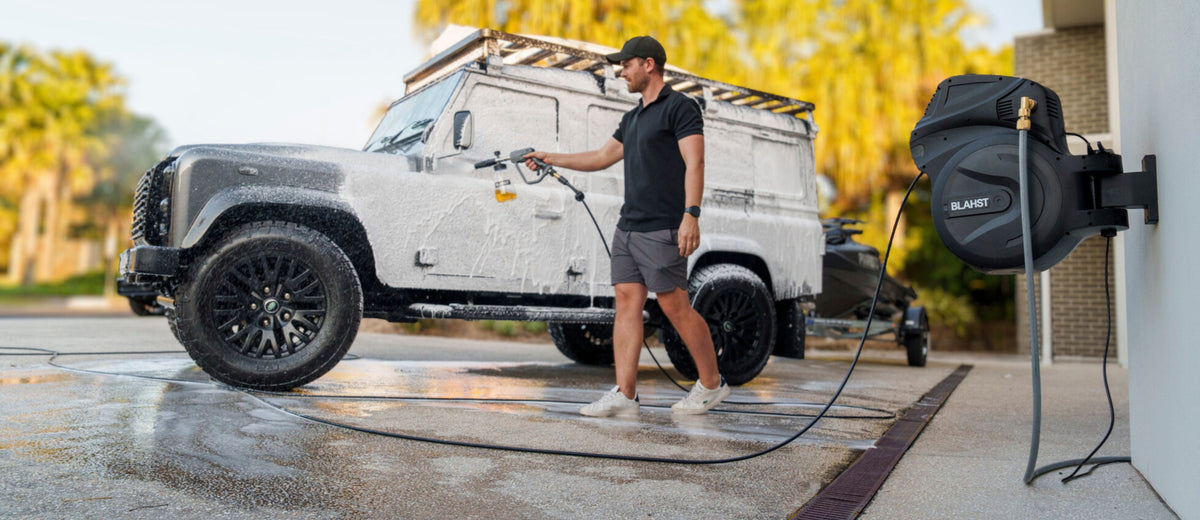
A BLAHST washer stays mounted with the hose retracted, so the wash starts when the bike comes off the ute, with nothing to set up or pack down. The R18 is sized for vehicle washing and lighter domestic cleaning; the R30 Wall-Mounted Pressure Washer is the step up when the same wall also washes a driveway. The R30 is rated at 2300 PSI working and 2600 PSI maximum; on a bike the 40 degree nozzle at 60 cm sets what reaches the parts, not the rating. Its 30 metre retractable hose reaches right around a car, 4WD, boat or caravan without moving the unit.
Next step: What PSI pressure washer is safe for a car?


Share: